

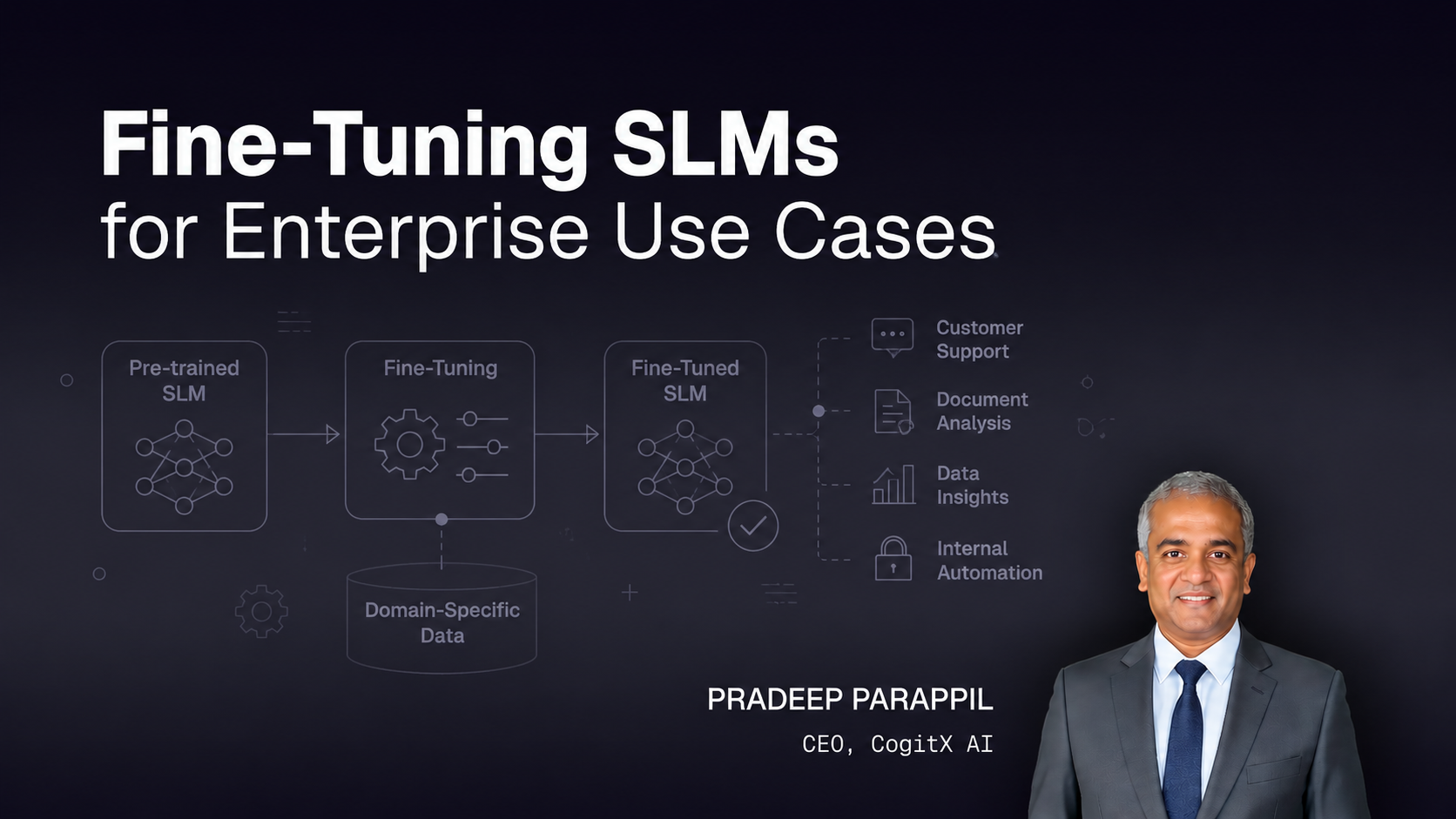
Fine-Tuning SLMs for Enterprise Use Cases
There is a clear pattern forming in enterprise AI deployments: teams that initially integrated frontier LLMs via API are now rebuilding parts of that stack around fine-tuned small language models. The motivations are operational, not ideological. Cost, latency, data governance, and deployment control are driving forces. This article works through how enterprise teams are approaching SLM fine-tuning in practice, what it takes to do it well, and where it breaks down.
Why Enterprises Are Choosing SLM Fine-Tuning
Inference Cost and Latency
At production scale, the economics of API-based LLM inference are hard to justify for high-volume, narrow tasks. A document classification model that handles 50,000 requests per day does not need the reasoning capacity of a 70B parameter model. A fine-tuned 7B model served on-premises reduces per-token cost substantially and removes per-call latency from the equation entirely.
Latency is a real constraint in customer-facing systems and internal copilots where response times matter. A quantized 7B model served with vLLM on a single A10G can sustain sub-200ms time-to-first-token for most enterprise prompts. A round-trip to an external API cannot reliably match that, especially under load.
Deployment Control and Data Governance
Many enterprises operate in environments where sending data to third-party APIs is a compliance or contractual problem. Healthcare, finance, legal, and government verticals routinely work with data that cannot leave their infrastructure. Fine-tuning an open-weight model and serving it on-premises solves this architecturally rather than through policy agreements. The model and the data stay within the organization's perimeter.
Beyond regulatory compliance, teams want deterministic behavior. External APIs change silently: model updates, safety policy adjustments, and rate limit changes all affect production systems. Owning the model version removes that dependency.
Domain Specialization
General-purpose models handle broad language tasks competently but often underperform on specialized terminology, output formats, or reasoning patterns native to a particular domain. A model fine-tuned on internal insurance claim narratives, structured legal clauses, or medical coding guidelines learns the vocabulary, format expectations, and entity relationships that a base model has to infer from a prompt. This matters for structured output tasks where format correctness is as important as content accuracy.
We covered the broader Small Language Model ecosystem, including architectures, deployment patterns, enterprise use cases, compression techniques, and leading SLMs like Phi, Gemma, and Mistral in our complete Small Language Models Comprehensive Guide.
When Fine-Tuning Makes Sense
Fine-tuning has a better signal-to-noise ratio in some task types than others.
Tasks where fine-tuning tends to perform well:
- Repetitive structured workflows: ticket classification, entity extraction, document routing, summarization with fixed output schema
- Internal copilots with narrow scope: code assistants constrained to a specific codebase or framework, HR policy Q&A, procurement query handling
- Compliance-sensitive outputs: models that must follow a specific format, citation style, or refusal pattern defined by internal policy
- Customer support systems: where consistent tone, terminology, and escalation logic matter more than broad world knowledge
- Domain-specific terminology: medical coding, legal clause analysis, technical documentation parsing where base models misinterpret jargon
Tasks where fine-tuning tends to underperform:
- Tasks requiring up-to-date knowledge (product inventory, live market data, recent regulatory changes)
- Open-ended reasoning that benefits from broad pretraining
- Workflows where the input distribution changes frequently
The practical test is whether the target behavior can be expressed as consistent patterns across a bounded input space. If it can, fine-tuning is usually worth exploring.
Fine-Tuning Techniques Used in Practice
LoRA and QLoRA
LoRA (Low-Rank Adaptation) is the standard approach for most enterprise fine-tuning workloads. The technique freezes the pretrained model weights and injects trainable low-rank matrices into the transformer attention layers. The number of trainable parameters is a small fraction of the full model, often around 1 to 5 percent. After training, the adapter weights can be merged back into the base model for inference, adding zero latency overhead.
QLoRA extends this by loading the base model in 4-bit NF4 quantization while training the low-rank adapters in 16-bit precision. This makes it possible to fine-tune a 7B parameter model on a single 24GB GPU. The quality delta versus full-precision LoRA is small enough to be acceptable for most production use cases. The compute cost reduction is significant. An 8-bit full fine-tune of a 7B model requires roughly 100GB of VRAM; QLoRA on the same model fits in a $1,500 consumer GPU.
PEFT and Adapter-Based Approaches
Hugging Face PEFT is the standard library for implementing LoRA and its variants. It handles adapter configuration, weight injection, and serialization. For multi-tenant systems that need to serve multiple fine-tuned adapters from a single base model, frameworks like S-LoRA and dLoRA batch adapter requests and manage memory scheduling to sustain throughput.
DoRA (Weight-Decomposed Low-Rank Adaptation), published at ICML 2024, decomposes weight matrices into magnitude and direction components before applying low-rank updates. It outperforms standard LoRA at equivalent rank on several benchmarks with no added inference overhead. Some teams are adopting it for tasks where LoRA underperforms full fine-tuning on direction-sensitive weight adjustments.
Instruction Tuning
Instruction tuning formats training examples as instruction-response pairs rather than raw text continuation. This teaches the model to follow task-specific directives, produce structured outputs, and respect formatting rules. It is the practical mechanism behind most enterprise fine-tuning pipelines. The training data looks like:
{ "instruction": "Extract all contract parties and effective date from the following clause.", "context": "This Agreement is entered into as of January 1, 2025...", "response": "{\\"parties\\": [\\"Acme Corp\\", \\"Vertex Ltd\\"], \\"effective_date\\": \\"2025-01-01\\"}"}
The quality of instruction-response pairs determines the quality of the fine-tuned model more than any hyperparameter choice.
If you want to understand the transformer architecture, tokenization, attention mechanisms, KV cache, quantization, and how small models actually run on-device, read our detailed guide on How Do Small Language Models Work.
Data Preparation for Enterprise Fine-Tuning
Data quality is the primary variable. Models fine-tuned on clean, consistent, representative data consistently outperform models trained on larger but noisier datasets.
Sourcing Training Data
Enterprise teams typically draw from three sources:
- Internal documents: SOPs, policy documents, past decisions, annotated outputs from existing workflows. These carry real domain knowledge but often require significant cleaning.
- Conversation logs: Support tickets, internal chat threads, past Q&A pairs. High signal but usually noisy and imbalanced.
- Synthetic data: LLM-generated instruction-response pairs grounded in internal documents. Scale AI's research on synthetic data strategies for fine-tuning, presented at NeurIPS 2024, shows that cost-effective synthetic generation is feasible when the generation strategy is carefully designed. Red Hat's SDG Hub demonstrates this pattern for domain-specific financial assistants, generating question-answer pairs from quarterly reports to teach models multi-hop reasoning over proprietary documents.
Data Cleaning and Format Consistency
Training examples with inconsistent formatting, contradictory outputs, or ambiguous instructions introduce noise that degrades generalization. Practical cleaning steps include:
- Deduplication at the semantic level, not just exact match
- Filtering out examples where the expected output is ambiguous or incorrect
- Normalizing output formats (JSON schema validation, whitespace rules)
- Removing PII before training, especially when logs are used
Evaluation Datasets
Teams that skip building a held-out evaluation set before training consistently regret it. A good evaluation set covers the actual distribution of production inputs, includes edge cases, and has ground-truth labels that can be checked programmatically. LLM-as-judge evaluation (using a capable model to score outputs) is increasingly common for open-ended tasks where exact match fails. It should be paired with task-specific metrics, not used in isolation.
Fine-Tuning vs RAG in Enterprise Systems
This is the most practically important architectural question for enterprise AI teams. The answer is rarely binary.
Where RAG Performs Better
RAG retrieves relevant documents at query time and injects them into the model's context. It is the right choice when:
- The knowledge base changes frequently (product catalogs, regulatory updates, policy documents)
- The corpus is large enough that fine-tuning cannot reliably encode specific facts
- Attribution and traceability are required — RAG can cite the source document, fine-tuning cannot
- Multiple user groups with different data access levels need to query the same system
The Microsoft Research paper on RAG vs fine-tuning found that RAG alone increases accuracy by approximately 5 percentage points on domain-specific tasks. RAG is also operationally simpler to update: changing the knowledge base does not require retraining.
Where Fine-Tuning Performs Better
Fine-tuning internalizes behavior, format, and reasoning patterns. It outperforms RAG when:
- The target behavior is a consistent output format or classification schema that does not depend on retrieving facts
- Latency is constrained and retrieval adds unacceptable overhead
- The domain vocabulary and structure differ enough from the base model's pretraining that retrieval context is insufficient to guide correct outputs
- The task is repetitive enough that training examples cover the input distribution reliably
The same Microsoft Research paper found fine-tuning adds approximately 6 percentage points in accuracy on top of the base model, and that gains are cumulative with RAG - meaning the two approaches are not mutually exclusive.
Combined Approaches
Many enterprise systems use fine-tuning and RAG together: a fine-tuned model handles output format, domain terminology, and task behavior, while RAG supplies the current factual content. The fine-tuned model learns to consume retrieved context effectively, which often requires including retrieval-augmented examples in the training data explicitly.
The operational tradeoff is complexity. A combined system has two failure surfaces: retrieval quality and generation quality. Debugging requires understanding both.
A lot of modern production systems now combine SLMs and LLMs together rather than treating them as competing approaches. We explored this in detail in SLMs vs LLMs.
Infrastructure and Deployment Considerations
GPU Constraints and Quantization
Most enterprise fine-tuning workloads run on A100 or H100 instances in the cloud, or on A10G/L40S hardware on-premises. QLoRA makes 7B model fine-tuning feasible on a single 24GB GPU. For inference, quantization to INT8 or INT4 reduces memory requirements significantly with acceptable quality degradation for most classification and extraction tasks.
INT4 quantization of a 7B model brings the weight footprint to roughly 4GB, making it deployable on hardware that teams already own. AWQ and GPTQ are the two dominant post-training quantization approaches; both are supported in vLLM and Hugging Face Text Generation Inference (TGI).
Inference Serving
For production serving, vLLM has become the default choice for its PagedAttention memory management, OpenAI-compatible API, and multi-GPU support. It handles continuous batching and achieves throughput gains of 2-24x over naive serving approaches. For organizations on NVIDIA hardware that want maximum throughput, TensorRT-LLM provides additional optimization at the cost of more complex deployment.
For air-gapped or on-premises environments, the toolchain looks like: base model weights stored on-premises, LoRA adapters version-controlled as artifacts, vLLM or TGI serving the merged model behind an internal API gateway, with logging and metrics piped to an existing observability stack.
Monitoring and Observability
Fine-tuned models in production need task-specific monitoring, not just infrastructure metrics. Useful signals include:
- Output format validity rate (for structured outputs)
- Confidence score distributions over time
- Refusal or null-response rates
- Latency percentiles (TTFT and TBT under load)
- Periodic sampling of outputs for human review
Model drift after deployment is underappreciated. A fine-tuned model does not update itself; if the input distribution shifts, quality degrades silently without monitoring to catch it.
Common Failure Modes
Catastrophic Forgetting
Research on continual fine-tuning confirms that fine-tuning on domain-specific data degrades general capabilities, and that larger models within the 1B-7B range experience more severe forgetting than smaller ones. Mitigation involves mixing domain-specific training data with a subset of general-purpose instruction pairs to maintain baseline behavior. LoRA's parameter efficiency offers some protection here — because base weights are frozen, forgetting is less severe than full fine-tuning, but it is not eliminated.
Overfitting on Small Datasets
Enterprise teams rarely have tens of thousands of clean, labeled examples. Fine-tuning on a few hundred poorly curated examples often produces a model that memorizes training patterns rather than generalizing. Symptoms include strong performance on training-similar inputs and sharp degradation on minor phrasing variations. Using a proper train/validation split and monitoring validation loss during training catches this early.
Weak Evaluation Pipelines
The most consistent failure pattern is launching a fine-tuned model without a rigorous evaluation framework. Without held-out test sets, task-specific metrics, and automated regression testing before each adapter update, quality regressions go undetected in production. This is an engineering discipline problem, not a modeling problem.
Hallucinations in Structured Tasks
Fine-tuning reduces but does not eliminate hallucination. For tasks where output accuracy is critical (medical coding, legal clause extraction, financial data extraction), a post-generation validation layer is necessary: schema validation, rule-based checks, or a secondary verification model. Fine-tuning a model to refuse to answer when uncertain, rather than guessing, is a tractable training objective that improves reliability on out-of-distribution inputs.
Outdated Domain Knowledge
A fine-tuned model encodes knowledge from its training data. If the fine-tuning data is six months old and the domain has changed, the model's outputs will reflect the older state. This is where RAG is the correct complement: use fine-tuning to set behavior and format, use retrieval to supply current facts.
Realistic Enterprise Adoption Patterns
Enterprise teams that are moving from pilot to production with fine-tuned SLMs tend to share a few common patterns:
Start Narrow
The most successful deployments start with a single, well-defined task with measurable outputs. Document classification and structured extraction are common starting points because they have clear evaluation metrics and narrow input distributions.
Use QLoRA by Default
For the majority of enterprise use cases, QLoRA on a 7B model is the practical starting point. It is compute-accessible, produces adapter artifacts that are easy to version and deploy, and the quality is adequate for most classification and extraction tasks. Full fine-tuning is reserved for tasks where LoRA demonstrably falls short.
Build the Evaluation Pipeline Before Training
Teams that define their evaluation set, metrics, and pass/fail thresholds before running a single training job produce better models faster. It forces clarity on what the model needs to do.
Why This Matters
Without predefined evaluation standards, model quality becomes subjective and difficult to measure consistently across iterations.
Version Adapters Like Software
LoRA adapters are small artifacts, often a few hundred megabytes. Treating them as versioned releases, with accompanying evaluation reports and rollback procedures, is the difference between a deployable system and an experiment.
Operational Advantage
Versioning adapters properly makes rollback, experimentation, auditing, and deployment management significantly easier in production systems.
Plan for Retraining Cycles
Domain knowledge drifts. Regulatory language changes. Internal processes evolve. Fine-tuned models are not set-and-forget. A realistic production system includes a retraining schedule, new data collection mechanisms, and the infrastructure to run evaluation and deployment without manual intervention.
Long-Term Reliability
Teams that treat retraining as part of the system design maintain model quality far more effectively over time.
The maturity curve runs from prompt engineering to RAG to fine-tuned RAG to fully custom model pipelines. Most enterprise teams are somewhere in the middle of that arc. Fine-tuning a small model for a specific workflow and deploying it on infrastructure the organization already controls is, for a growing number of use cases, the most practical path to reliable, cost-effective AI in production.