

If you've sat through enough vendor pitches this past year, you've heard AI agents and agentic AI used interchangeably — sometimes in the same sentence. For enterprise leaders making real technology decisions, that confusion is expensive. The difference between an AI agent and an agentic AI system is the difference between buying a hammer and building a construction firm.
I have worked with a whole host of enterprise customers and GCCs on designing and deploying agentic workflows. The single most common mistake I see is organisations investing in the wrong architecture for the problem they're trying to solve — because no one took the time to explain the distinction clearly.
This article does exactly that.
TL;DR
AI Agent — a software system that executes one specific task autonomously when triggered.
Agentic AI — a system that takes a high-level goal, figures out the steps on its own, and keeps adapting until the job is done.
An AI agent is built for one specific job. Agentic AI is built around an outcome — orchestrating tools, data, and decisions to actually get there.
Take vendor onboarding as an example:
- An AI agent handles one defined step — say, automatically running a compliance check.
- Agentic AI takes the goal "onboard this vendor" and works backward. It figures out that it needs to verify documents, run compliance checks, flag missing information, loop in the right teams, and follow up until the job is done. Nobody hands it a checklist. It builds the path to the outcome itself.
What is an AI Agent? And Why It's Not Enough on Its Own
An AI agent is an autonomous or semi-autonomous software entity that perceives inputs, makes decisions, takes actions, and completes specific goals — all within well-defined boundaries.
You write a prompt, the agent reads it, executes the task, gives you a result. It does exactly what it was told — nothing more. Think of it like a specialist:
- A customer support agent that resolves tickets
- A data extraction agent that pulls and structures information from documents
- A monitoring agent that detects anomalies and raises alerts
Each one is sharp, reliable, and fast — but only within its domain. For enterprises, AI agents deliver real ROI on high-volume, repetitive, well-understood tasks: invoice processing, document classification, fraud flagging, IT helpdesk responses. The value is clear and measurable.
But the moment the goal shifts or something unexpected comes up, it stops. It has no awareness of the bigger picture, no sense of why it's doing what it's doing. It needs a human to course correct every time it hits a wall.
What is Agentic AI? How It Goes Further Than a Single Agent
Agentic AI is a system that takes a high-level goal, breaks it down into steps on its own, executes those steps — often coordinating multiple AI agents — and keeps adapting until the job is done.
The problem space becomes much larger. Think about:
- Vendor onboarding end-to-end
- Handling customer support across email, text, and voice simultaneously
- Building and executing a marketing campaign from brief to launch
Agentic AI figures out what needs to happen, in what order, and using which tools. If something doesn't work, it doesn't stop and wait. It adjusts. Think of it less like a tool you operate and more like a system that operates toward a goal.
This is where things get powerful for enterprises — handling workflows that are too complex, too dynamic, or too cross-functional for a single AI agent to manage. But autonomy without architecture is just unpredictability with a better name. Agentic AI needs clear goals, solid guardrails, and the right engineering underneath it. Without those, the autonomy becomes the liability.
AI Agents vs. Agentic AI: Side-by-Side Comparison
How Agentic AI is Built on Top of AI Agents — The Architecture Explained
Here is the insight most vendor conversations skip: Agentic AI is not a different category of technology. It is an architectural evolution of AI agents.
Every agentic system is built on the same foundation as a single AI agent. The architecture doesn't change — it expands. What makes a system agentic is not a different kind of AI, but additional layers of capability stacked on top: memory, reasoning loops, self-correction, and orchestration. Understanding this progression is what lets you cut through vendor noise and ask the right questions.
The Anatomy of an AI Agent
Four layers, stacked on top of each other:
- Input — something triggers it. A message, a scheduled task, or an API call.
- Brain — an LLM reads the input and figures out what to do.
- Tools — it reaches out to whatever it needs: a database, a CRM, an external API.
- Output — it returns a response or completes an action in your system.
Clean, predictable, and relatively straightforward to build and maintain. The tradeoff is that it only works within these four walls. The moment the goal changes or the path is unclear, it stops.
The Architectural Evolution: From Agent to Agentic AI
Agentic AI takes the same four-layer foundation and adds what's needed to handle goals that don't have a fixed path:
- Memory — it remembers what happened before. Not just in this session, but across past runs. If it tried something last week and it failed, it won't try the same thing again. This is what makes the system learn over time rather than reset.
- Reasoning loops — instead of acting once, it thinks → acts → checks the result → thinks again. It keeps doing this until the goal is done or it decides to hand off to a human. This is what makes it adaptive rather than reactive.
- Self-correction — if something breaks mid-way, it doesn't crash. It figures out what went wrong and tries a different route. This is what makes it resilient rather than fragile.
- Orchestration — for bigger goals, it breaks the work into smaller pieces and hands each piece to a specialised agent, then pulls everything back together. This is what makes it scalable to complex, cross-functional workflows.
When a vendor shows you an "agentic AI" product, the right question is not "does it use agents?" — almost every tool does now. The right question is "which of these four layers has actually been engineered, and how?" That answer tells you whether you're looking at a point solution with a new label, or real agentic infrastructure.
A Practical Example to Understand Agentic AI vs AI Agents
The difference between the two can be best understood through a simple analogy from Cornell research, same house, same problem of home HVAC, yet two completely different systems solving it.
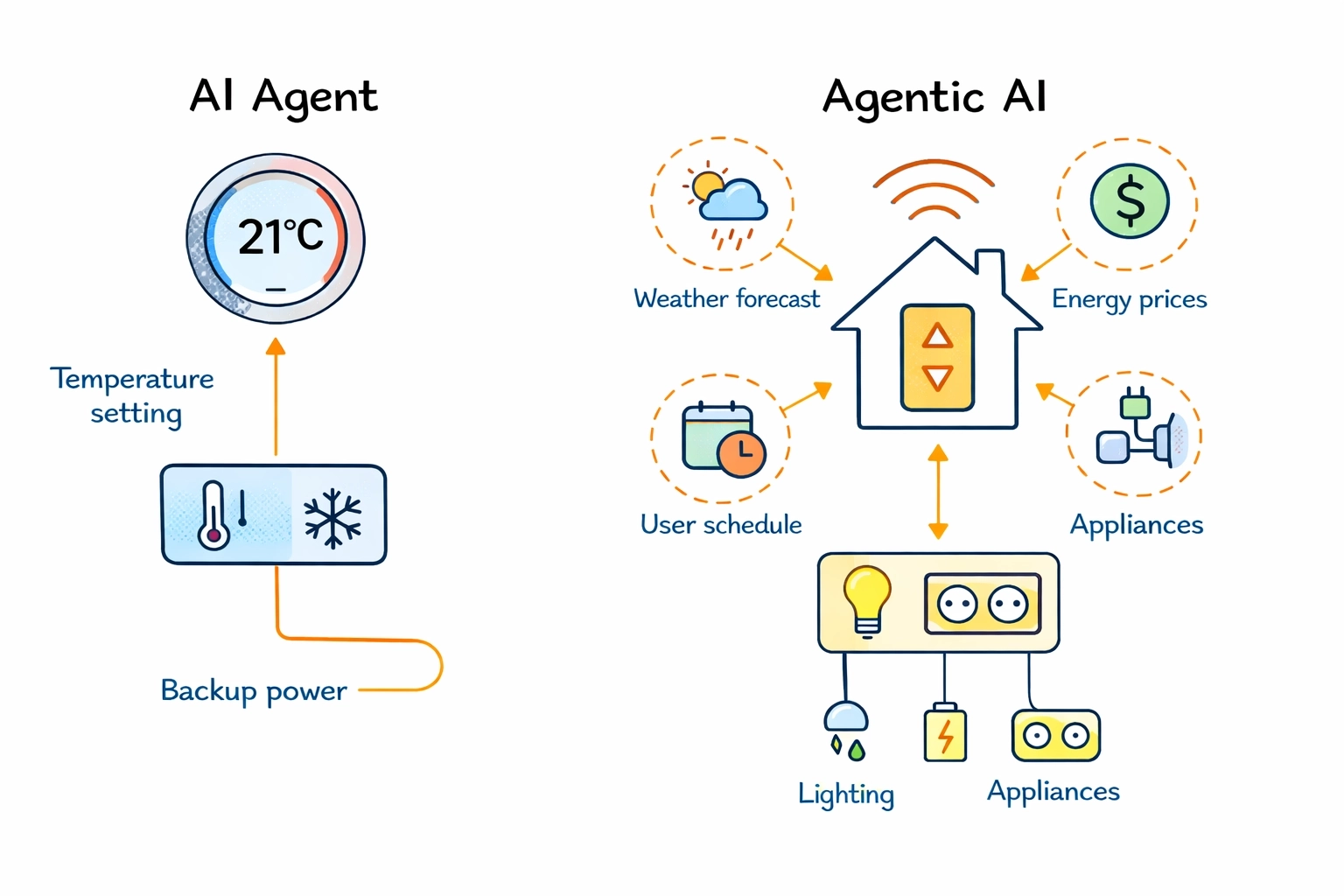
The thermostat on the left is your AI Agent.
- You set it to 21°C, it keeps it at 21°C
- One input, one job, zero awareness of anything else
- Change the setting and it follows. Don't change it and it runs the same way forever
The smart home system on the right is your Agentic AI.
Nobody told it to turn down the heating at 3pm. It figured that out on its own, because it:
- Checked the weather forecast
- Noticed energy prices were high
- Saw that your schedule shows you're not home until 6pm
- Adjusted the lighting and appliances accordingly
Every decision it made was in service of one goal: running your home efficiently.
That is the difference. One executes what it is told. The other works toward what you actually want.
AI Agent Tools vs. Agentic AI Platforms: Which One Does Your Enterprise Actually Need?
Every vendor today claims to have "AI agents." Some do. But there is a meaningful difference between vendors selling point solutions, vendors selling raw infrastructure, and a third category that sits between them. Knowing which is which will save you from expensive mistakes.
Category 1: Point Solution Vendors — Fast ROI, Real Ceiling
These are purpose-built tools that automate a specific, well-defined job. They deploy quickly, deliver measurable ROI, and are easy to justify internally. If you have a clear, repetitive, well-scoped problem, they can be the right call.
Salesforce Agentforce — Automates sales and service workflows inside the Salesforce ecosystem: lead qualification, case routing, tier-1 support. Strong if you're already deep in Salesforce. If your data lives outside it, the value drops fast. It is an agent within a walled garden — useful inside, limited beyond.
Microsoft Copilot — Embeds AI into Teams, Outlook, Word, and Excel. Summarises meetings, drafts emails, generates reports. Best for Microsoft 365-heavy organisations. Worth being clear about what it is: a productivity layer, not a workflow engine. It assists with tasks. It does not own outcomes.
IBM watsonx Assistant — Conversational AI for customer service and internal support, handling high volumes of repetitive queries. Narrow by design. Extending it beyond its intended domain requires substantial configuration — and often, custom engineering that erodes the original cost case.
Oracle AI Agents — Role-based agents embedded in Oracle Fusion Cloud for finance, HR, and supply chain tasks. Powerful inside Oracle's ecosystem. The same constraint applies as Salesforce: strong within the walled garden, limited outside it.
Moveworks — IT and HR helpdesk automation. Resolves employee requests — password resets, access requests, policy questions — without human intervention. Built for one function. Does not extend to cross-functional or dynamic multi-step goals.
The honest pattern: each of these solves one problem, in one place, within one system. That is a feature when you have the right problem. It becomes a liability when you try to stretch a point solution across a complex, cross-functional outcome. Organisations that take this path typically end up buying five tools, managing five vendors, and still needing a human to connect them.
Category 2: Infrastructure Platforms — Maximum Capability, Maximum Engineering Investment
These platforms are built for goals, not tasks. They give you the infrastructure to construct agentic systems that own entire workflows, adapt when things change, and coordinate across systems. The tradeoff is significant: they require mature AI/ML engineering teams to extract value. This is not off-the-shelf software. It is a foundation you build on.
AWS Bedrock Agents / AgentCore — Infrastructure for building custom agentic systems on top of multiple foundation models. The right choice for enterprises with strong in-house AI/ML teams who want to build proprietary workflows from the ground up. Without that team, time-to-value is long and execution risk is high.
Google Vertex AI Agent Builder — A managed platform for building and deploying multi-agent systems grounded in enterprise data. Strong reasoning across complex information environments. Requires the engineering capability to build on top of it — it is a platform, not a deployed solution.
LangChain / LangGraph (open source) — Frameworks for building custom agentic workflows with full control over memory, reasoning loops, and orchestration. Zero vendor lock-in, maximum flexibility. The tradeoff: you own the full implementation — including debugging, scaling, security, and governance. Powerful in the right hands, a significant liability in the wrong ones.
Palantir AIP — Builds a live operational model of your business and deploys agents that reason across it. Strong in high-stakes, data-sensitive industries. Requires deep Palantir engagement to implement — high capability, high commitment.
The honest pattern: enormous capability, but the ceiling on what you can build is essentially the capacity of your engineering team. If you have a world-class AI/ML function and the runway to build, these platforms give you maximum control. If you don't — or need to move faster than a build-from-scratch timeline allows — you need something different.
Where CogitX Fits: Agentic Depth, Without the Engineering Overhead
Most enterprises find themselves stuck between two options that don't quite fit: point solutions too narrow for complex problems, and infrastructure platforms that require engineering teams they don't have.
CogitX is built for that gap.
It gives you the architectural depth of an agentic platform — memory, reasoning loops, multi-agent orchestration, bounded autonomy, governance controls — without requiring you to build or manage the underlying infrastructure. The agentic system is pre-engineered. What you configure is the goal, the guardrails, and the workflows specific to your business.
In practice, this means:
- No large AI/ML engineering team required. The infrastructure is already built. Your team configures outcomes, not architecture.
- Not ecosystem-locked. CogitX integrates across your existing stack — CRM, ERP, support platforms, data systems — rather than replacing it with a walled garden.
- Start focused, scale deliberately. Begin with a specific, high-value use case and extend to cross-functional, multi-agent workflows as your confidence and governance maturity grows.
- Governance built in from the start — not added after deployment, which is where most agentic implementations run into regulatory and operational trouble.
The organisations winning with agentic AI didn't buy the most powerful infrastructure. They bought the right fit for their team, their governance requirements, and their actual business goals.
So, Which One Do You Actually Need?
If you have a specific, well-scoped problem — automate this workflow, reduce tickets in this department, speed up this approval process — a point solution is the right starting point. Fast ROI, low risk, easy to justify.
But if you're looking at problems that cut across departments, involve dynamic decisions, or require your AI to keep working when the path isn't clear — that's where point solutions hit their ceiling quietly. You'll find yourself managing five vendors and still needing a human to connect everything.
That's not a tooling problem. That's an architecture problem. And it's exactly the problem agentic AI is built to solve.
CogitX works with enterprises to design, deploy, and govern agentic AI systems built for scale, compliance, and real business outcomes — without requiring you to build the infrastructure from scratch.
Talk to the CogitX team to find out where agentic AI can move the needle for your organisation.
About the author
Pradeep is the CEO of CogitX, where he leads AI governance and agentic platform implementations across enterprise and GCC clients. Having worked across the full stack of AI deployment — from architecture design to governance frameworks to regulatory compliance — he has a front-row seat to what it actually takes to move from AI pilots to production-grade agentic systems.